

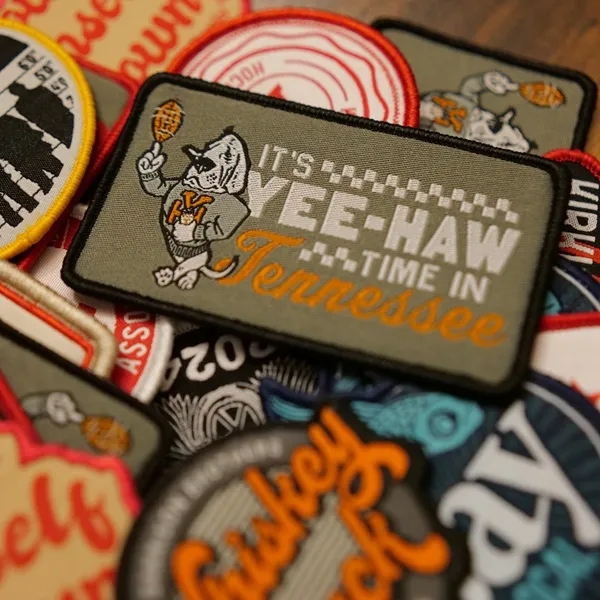
This guide explains what separates them, when each one works best, and how to choose without second guessing.
What is an embroidered badge?
When comparing woven badges, an embroidered badge is made by stitching threads directly into a fabric base to build up the design. Because the thread sits on top, the finish is slightly raised and textured.
They suit bold shapes, simple text, and classic logos, especially when a traditional, premium look matters more than tiny detail.
What is a woven badge?
A woven badge is made by weaving coloured threads together on a loom to form the design as part of the fabric itself. Instead of raised stitching, the surface is flatter and smoother.
They are better for fine lines, small lettering, gradients, and intricate logos, where clarity is the priority.
How do woven badges and embroidery look different up close?
Embroidered badges look more textured because the stitches create a visible thread pattern and a slight 3D effect. That texture often reads as “heritage” or “handcrafted”, even when produced at scale.
Woven badges look cleaner and more printed-like. Because the threads are thinner and tightly woven, edges and small text usually appear sharper.”
Which option handles small text and fine detail better?
Woven badges almost always win for small text and intricate detail. The weave can hold thin lines and tight curves without the “stitch stepping” that embroidery can introduce.
Embroidery can still include text, but it generally needs to be larger and bolder. If the design relies on tiny lettering, woven is usually the safer choice.
Which one feels more premium?
Embroidery often feels more premium when a badge is meant to be noticed by touch as well as sight. The raised thread, heavier feel, and traditional finish are why it is common on club crests, uniforms, and heritage-style branding.
Woven badges feel premium in a different way. They tend to look more refined and precise, which suits modern logos, detailed artwork, and fashion labels aiming for a sleek finish.
Are woven badges more durable than embroidered badges?
Both can be durable, but they fail in different ways depending on use and finishing.
Embroidery can snag if the stitches are exposed and the badge rubs against rough surfaces. Woven badges are flatter, so they are less likely to catch, but the threads are finer, so edge finishing matters more. In practice, durability depends heavily on backing, border type, and how the badge is attached.
How do they compare for comfort on clothing?
Woven badges are typically thinner and sit flatter, which can feel more comfortable on lightweight garments. They are often chosen for items worn close to the skin, such as caps, polos, and fashion pieces.
Embroidered badges can feel slightly bulkier and stiffer, especially with dense stitching. That is not usually a problem on outerwear, uniforms, or bags, but it can matter on thinner fabrics.
Which option works better for colour and shading?
Woven badges handle colour transitions and subtle detail better. While neither is “photo quality”, weaving can mimic smoother gradients and crisp colour boundaries.
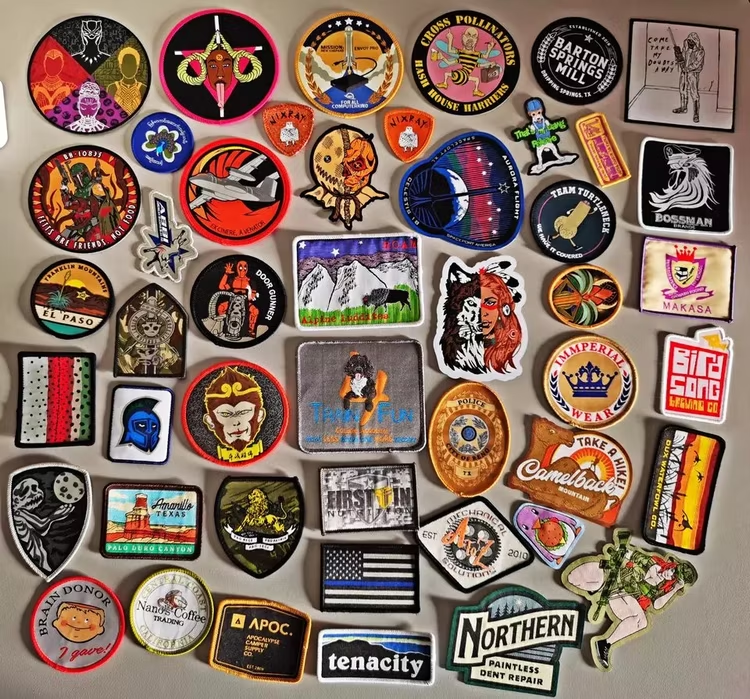
Embroidery tends to simplify shading because it relies on stitch direction and thread blocks. It can still look excellent, but the design often needs to be adapted so it reads clearly in thread. See how blazer patches improve uniform branding.
What backing and edge finishes should they consider?
Backing and borders often matter as much as the badge type.
Common backings include iron-on, sew-on, Velcro, and adhesive. Iron-on is convenient but not always ideal for high-wash uniforms. Sew-on is the most secure long term. Velcro is popular for tactical, workwear, and interchangeable patches.
For edges, merrowed borders create a rounded, stitched frame that suits embroidery and bold shapes. Heat-cut or laser-cut edges give a cleaner, flatter outline, which pairs well with woven badges and detailed silhouettes.
How should they choose between woven and embroidered badges?
They should choose woven badges when the design includes small text, fine lines, or crisp detail, and when a flatter, cleaner look is preferred. They should choose embroidered badges when the design is bold, simple, and meant to feel textured and traditional.
A quick rule works well: if the logo needs to be read at arm’s length, embroidery is often enough. If it needs to be read up close, woven is usually better.
What is the simplest way to avoid a bad result?
They should ask for a digital proof that shows thread style, border, size, and backing, then check the smallest text and thinnest lines first. Most disappointment comes from choosing a badge style that cannot reproduce the detail at the intended size.
If they are unsure, they can request a sample or ask the maker to recommend a stitch or weave option based on the artwork. The right choice is usually obvious once the design is tested at real-world dimensions.
FAQs (Frequently Asked Questions)
What is the main difference between embroidered and woven badges?
Embroidered badges are created by stitching threads directly onto a fabric base, resulting in a raised, textured finish ideal for bold shapes and simple text. Woven badges are made by weaving coloured threads together on a loom, producing a flatter, smoother surface that excels in fine lines and intricate details.
Which badge type is better for small text and detailed logos?
Woven badges are superior for small text and intricate designs due to their ability to hold thin lines and tight curves without the stitch stepping effect seen in embroidery. Embroidered badges typically require larger, bolder text to maintain clarity.
How do embroidered and woven badges differ in terms of durability?
Both badge types can be durable but fail differently depending on use. Embroidered badges may snag if stitches are exposed and rub against rough surfaces, while woven badges have finer threads requiring careful edge finishing. Durability also depends heavily on backing, border type, and attachment method.
Which badge option feels more comfortable on clothing?
Woven badges are generally thinner and sit flatter, making them more comfortable on lightweight garments worn close to the skin such as caps or polos. Embroidered badges can feel bulkier and stiffer, which suits outerwear or bags but may be less comfortable on thinner fabrics.
What backing and edge finishes should I consider for my badge?
Common backings include iron-on for convenience, sew-on for long-term security, Velcro for tactical or interchangeable patches, and adhesive options. Merrowed borders provide a rounded stitched frame suitable for embroidery, while heat-cut or laser-cut edges offer a cleaner outline ideal for woven badges with detailed shapes.
How do I choose between woven and embroidered badges for my design?
Choose woven badges when your design includes small text, fine lines, or requires a flatter, cleaner look. Opt for embroidered badges when your design is bold, simple, and benefits from a textured, traditional feel. A practical rule: embroidery works well if the logo is viewed from arm’s length; woven is better for close-up clarity.